Business Process Automation
Your team stops doing by hand what software can do automatically.
From $900 · Fixed-scope quote before work begins · Digital delivery
Your tools should talk to each other. Most of them don't — yet.
The average small business uses 8–15 software tools. Almost none of them communicate automatically. Data gets copied from your CRM into your project tool by hand. Invoices get triggered manually after a sale closes. Reports get built by pulling numbers from three different places every Friday afternoon. Nobody decided this is how it should work — it just grew this way.
Business process automation connects your existing tools and makes the repetitive steps happen without human intervention. Data moves, notifications send, records update, and reports generate — on schedule or when triggered by a specific event — with no one manually in the loop. We build the automation, test it, and document exactly how it works so you understand what is happening and why.
Who this service is for
This service is a good fit if any of the following describes your situation.
Your team copies the same data from one system to another — CRM to spreadsheet, form submission to project tool, sale to invoice — every day.
Customer notifications (confirmations, reminders, follow-ups) are sent manually and sometimes don't get sent at all.
You're generating reports by pulling numbers from multiple tools, every week, by hand.
You onboard new clients or employees with a checklist that someone has to work through manually each time.
You've heard of Zapier but the tools you use aren't in its catalogue, or the workflow is too complex for a no-code connector.
A new hire started and you realized how much of your process depends on one person remembering to do things at the right time.
What you get
Everything included in the scope, delivered by the agreed date.
- A complete automation of the agreed workflow — from trigger to final action — tested end-to-end
- A written scope document defining the workflow, the tools connected, and the triggers before work begins
- Integration with your existing software using APIs, webhooks, or scripts as appropriate
- A plain-English documentation file describing what the automation does, when it runs, and how to monitor it
- Error handling so that failures are logged and you are notified — not silently lost
- Testing with real or realistic data before handover
- A 30-day post-delivery support window
- Recommendations for what to automate next, if relevant
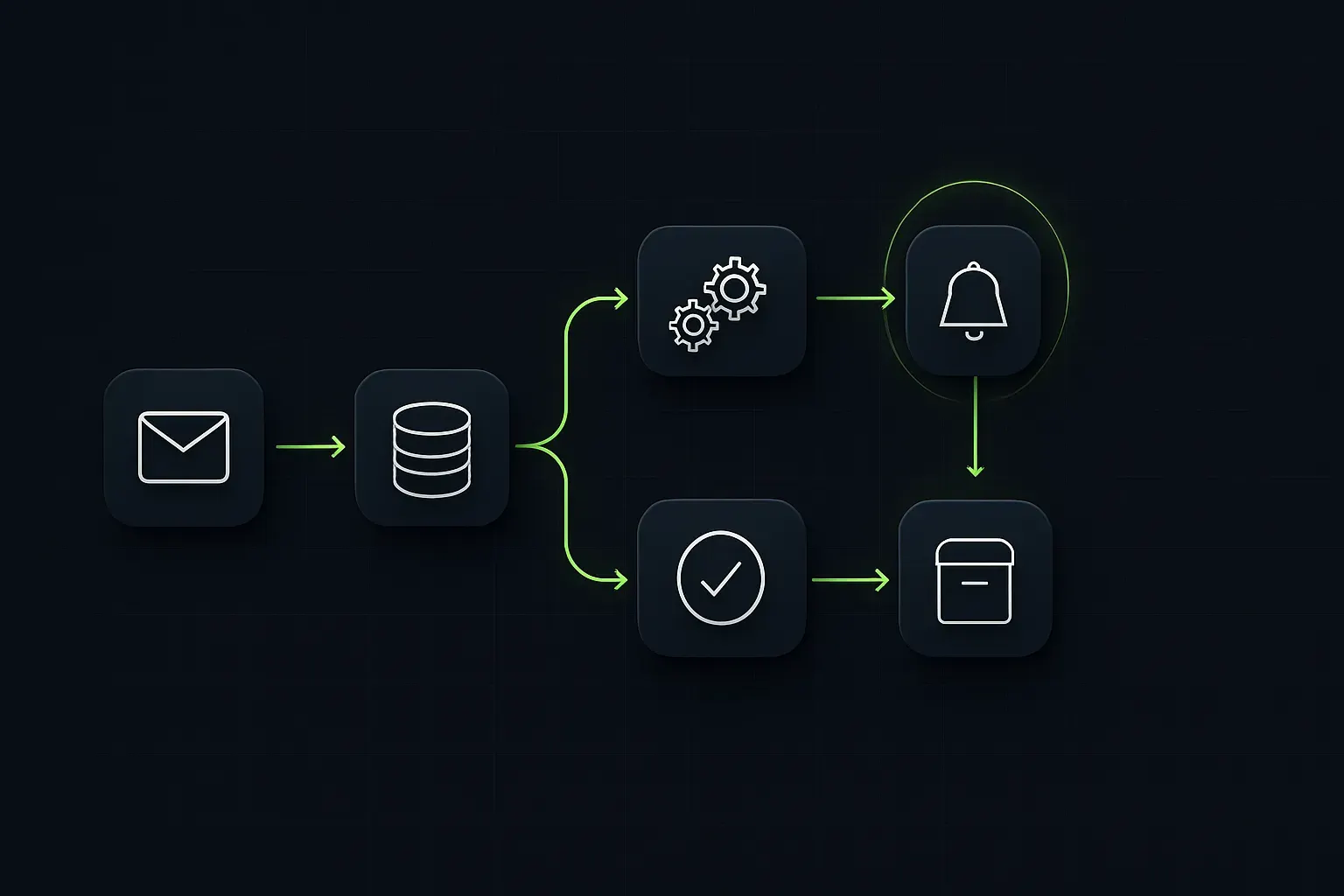
How it works
Step by step, from your first message to receiving the deliverable.
You describe the manual process
Walk us through the current workflow — what triggers it, what steps happen, which tools are involved, what the end result should be. Voice call, written description, or a loom recording — whatever is easiest for you.
We map and scope it
We map the complete workflow, identify the integration points, and send you a scope document describing what the automation will do and how, at a fixed price.
We build and test it
We build the automation, test it with real data (or a staging environment), verify every branch and edge case, and confirm the error handling works.
The workflow runs itself
We hand over the documented automation. From this point, the process runs without anyone in the loop. We monitor during the 30-day support window to catch anything unexpected.
E-commerce operator reclaims 8+ hours per week
An online retailer was manually transferring order data from their storefront to their inventory system and then to their shipping platform — three tools, twice a day, by hand. We connected the three systems through a custom automation: when an order is placed, it flows through to inventory and shipping automatically. The manual transfer step no longer exists.
Sample project — illustrative
"I described the workflow to them on a call — it took 20 minutes. They sent a scope the next day with a price I could approve with a clear conscience. Two weeks later the process just... ran itself. I hadn't realized how much mental energy I was spending on those manual steps until they were gone."
Transparent pricing. Fixed scope.
Simple single-step automations (connect two tools, move data when a form is submitted) typically start from $900. Multi-step workflows connecting three or more tools, with branching logic and error handling, typically start from $1,800. Complex enterprise-grade automation pipelines are scoped individually. Every project is fixed-price.
- Two-tool connection
- Single trigger type
- Basic error notification
- Documentation
- 30-day support
- Three or more tools
- Branching logic
- Conditional approval steps
- Full error handling & logging
- Monitoring setup
- Complex enterprise workflows
- Custom API integrations
- Full discovery & mapping
- Dedicated project management
- Ongoing optimisation
Common questions
No. We automate your existing tools. You don't need to buy new software or migrate to a different platform. The automation works around what you already have.
If your tools have an API or webhook support, we can almost certainly automate between them. If a tool has no integration options at all, we'll tell you at the scoping stage — not after you've paid.
Every automation we build includes error handling and logging. If a step fails, you get a notification — you are never left with data silently lost or a workflow stopped without knowing. The 30-day support window covers any issues that surface post-delivery.
Yes. Automations can include conditional branches — "if the invoice is over $500, send for manager approval before proceeding." We map the full workflow including any steps that require a human decision.
No. Automation removes the machine-level work — the copying, the pasting, the repetitive steps — so your team can focus on the work that requires judgment, relationships, and creativity. It doesn't replace people; it stops people being used as manual data pipes.
You might also need
What could your team stop doing by hand?
Tell us the manual process. We'll map it, price it, and automate it — fixed scope, no surprises.